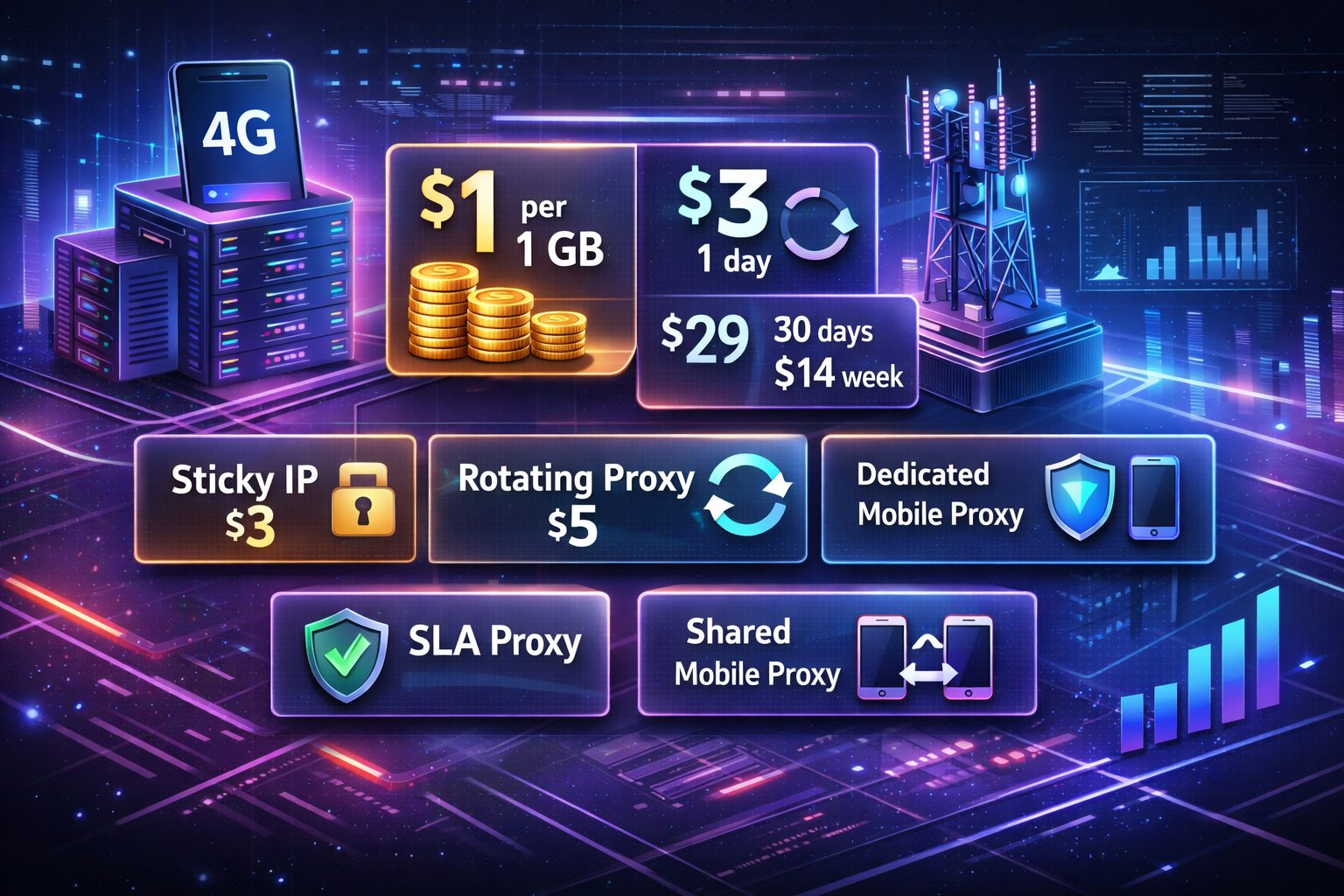
Mobile proxy pricing for Ukraine: what you actually buy
When people search for “mobile proxy price Ukraine”, they often compare only the number on the plan. But a mobile proxy is not just an IP address. It is a service: SIM/modem pool management, rotation logic, carrier constraints, anti‑fraud resilience, support, quality control, and (sometimes) an SLA. That is why two plans with similar labels can perform very differently in bans, CAPTCHAs, and downtime.
This guide explains the common pricing models (unlimited vs pay‑per‑GB), why sticky add‑ons can be worth it, and how to justify “expensive” using practical KPIs: ban risk, downtime cost, and pool quality.
Two core billing models: unlimited vs pay-per-GB
- Unlimited (flat subscription) — you pay a fixed fee for access (ports/locations/plan) and traffic is marketed as “unlimited”.
- Pay‑per‑GB — you pay for consumed bandwidth (often with a minimum package), while concurrency/ports may be priced separately.
In mobile proxies, “unlimited” usually means fair usage. After a certain threshold, you may see prioritization, speed reduction, or extra rules. Always compare the details: concurrency limits, rotation rules, support level, and monitoring.
When unlimited makes sense
Unlimited tends to win when your bandwidth is high and predictable, and per‑GB pricing becomes painful at scale. Typical cases:
- Traffic arbitrage / multi‑accounting: frequent logins, warming profiles, uploading creatives, checking dashboards.
- QA / automation: long session flows (login → checkout → payment), geo‑specific feature testing.
- Long‑running scraping: media, large API responses, retries — bandwidth grows fast.
The benefit is budget predictability. The risk is hidden “fair usage” constraints, so validate speed and stability under your real load.
When pay-per-GB is a better fit
Pay‑per‑GB works best when traffic is low or irregular, and you want granular cost control.
- SEO checks (SERP, local results): many requests, but relatively small pages if optimized.
- Scheduled scraping with modest output volumes.
- Pilot testing of geo, anti‑fraud behavior, and pool quality before scaling.
If you optimize bandwidth (disable images, compress responses, cache where possible), pay‑per‑GB can be the cheapest entry point.
Why sticky IP often costs extra
A sticky session keeps the same IP for a period of time (or until you rotate it manually). For the provider, this requires stronger session stability and often a tighter binding to a specific modem/channel. That is why sticky is frequently priced as an add‑on.
- Fewer breaks in multi‑step flows (login, 2FA, uploads, settings).
- Less anti‑fraud noise when the IP does not change mid‑session.
- Control: you decide when to rotate.
For arbitrage and account work, sticky can be critical. For high‑volume scraping, rotating mode is often more efficient.
Rotating mode: what you pay for
Rotating mobile proxies require operational automation: reconnect logic, health checks, pool sizing, and monitoring. Price differences are often driven by pool quality (how often IPs repeat) and how cleanly the provider handles rotation.
Shared vs dedicated mobile proxies
- Shared — the same pool/modem resources are used by multiple customers (with concurrency limits).
- Dedicated — resources are reserved for you (a port/modem/line or a dedicated pool segment).
Dedicated costs more, but reduces “neighbor risk”: other users’ traffic spikes, suspicious activity, and collateral bans. For sensitive platforms, that reduction in risk can pay back quickly.
Proxy SLA: what to verify
An SLA (Service Level Agreement) is a set of measurable commitments: uptime/availability, support response times, incident handling, and sometimes compensation rules or recovery targets.
- How uptime is calculated (maintenance windows, measurement period).
- Support channels and time to first response/escalation.
- Compensation terms (credits/refunds and thresholds).
- Liability boundaries (e.g., carrier‑level issues).
What different teams usually buy
- Arbitrage: dedicated or semi‑dedicated + sticky; focus is minimizing bans and session drops.
- SEO: pay‑per‑GB or small packages; short tasks and bandwidth optimization matter.
- QA: unlimited or large packages + sticky; reliability and support are key.
Turn “expensive” into KPIs
- Ban cost: time and assets lost when an account is banned (warm‑up, creatives, data, tooling).
- Downtime cost: revenue or productivity lost per hour when campaigns/scrapers/tests are blocked.
- Poor pool cost: extra CAPTCHAs, retries, and slowdowns that inflate time and bandwidth.
If a cheaper service causes even a small number of extra incidents per month, the apparent savings often disappear.
10‑minute decision checklist
- Your average daily bandwidth (GB) and peak days.
- Time lost to proxy issues (drops, CAPTCHAs, ban waves).
- Your internal cost of one hour of downtime and one ban.
High stable bandwidth → often unlimited. Irregular usage or early stage → pay‑per‑GB. Long sessions → sticky. High downtime cost → prefer a plan with a clear SLA and fast support.
Conclusion
Mobile proxy pricing for Ukraine is a trade‑off between budget and risk. Unlimited is about predictability at high volume, pay‑per‑GB is about flexible control. Sticky add‑ons protect long sessions, and an SLA protects you when downtime is expensive. Evaluate plans through KPIs: fewer bans, less downtime, and a healthier pool.