Why the IP “origin” matters
When you buy proxies, you are choosing how a website will classify your traffic: mobile carrier, home broadband, ISP-registered static, or datacenter hosting. That classification affects logins, CAPTCHAs, long sessions, and how quickly a target will rate-limit or ban you.
Most failures come from picking the “strongest” proxy type without matching it to the workflow. The practical choice is a balance of trust, session stability, speed, and cost. This guide compares mobile, residential, ISP, and datacenter IPs and shows when mobile proxies are justified—and when another type is the better tool.
Definitions (in plain terms)
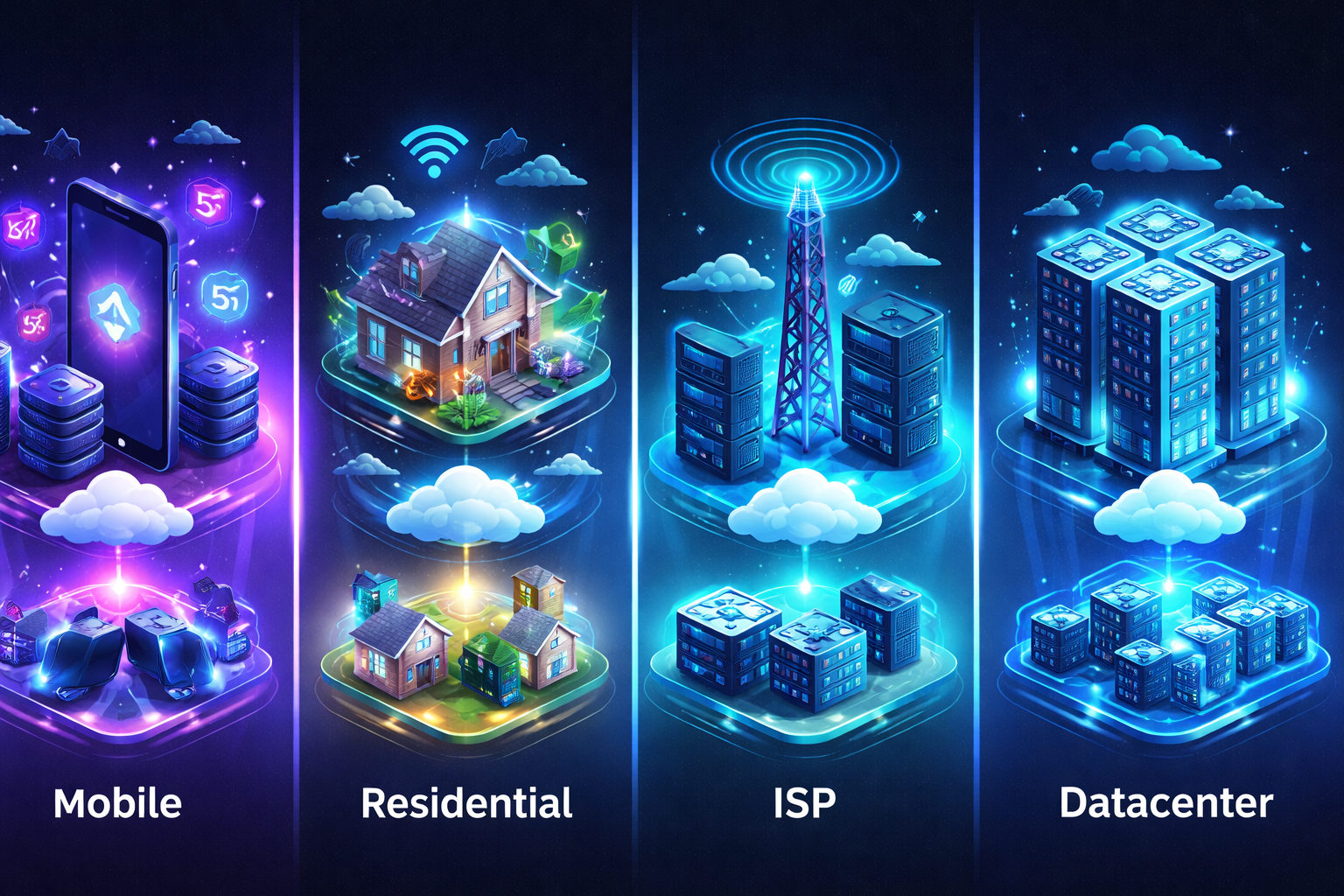
- Mobile proxies use IPs from mobile carriers (4G/LTE/5G), often rotating and frequently shared via CGNAT pools.
- Residential proxies use IPs assigned to real home connections (fiber/cable/DSL).
- ISP proxies (often called static residential) combine ISP-registered IP space with datacenter-grade hosting for speed and stability.
- Datacenter proxies use hosting provider IPs—fast and cheap, but commonly flagged by anti-bot systems.
How websites infer proxy type
Modern defenses look at more than IP: ASN reputation, subnet history, request patterns, device/browser signals, geo consistency, and account behavior. Still, ASN and IP origin can block you before the page renders—especially with datacenter ranges.
Quick comparison
- Trust: mobile ≈ residential > ISP > datacenter (typical, not universal).
- Session stability: ISP (static) > datacenter > residential (depends on rotation) > mobile (often rotates more).
- Speed: datacenter > ISP > residential ≈ mobile.
- Cost: datacenter (lowest) < ISP < residential < mobile (often highest).
When mobile proxies are worth it
Mobile IPs come from carrier networks and often look like “normal” user traffic because mobile addressing is dynamic and frequently shared (CGNAT). That can reduce the default suspicion attached to server ranges.
- High-friction anti-fraud environments: social platforms, aggressive risk scoring, account warm-up, repeated logins/verification.
- Mobile-specific testing: validating mobile SERPs, geo behavior in carrier networks, app/web parity checks.
- Fast “reset” after a challenge: rotating to a fresh carrier IP can help when a specific address is challenged.
Mobile is usually a poor fit for heavy bandwidth scraping or workflows that require a stable IP for hours or days, because frequent IP changes can itself look suspicious.
Residential proxies: the common default
Residential IPs resemble household traffic and often unblock targets that dislike datacenter ASNs. Quality varies widely by provider, rotation policy, and subnet history.
- Best for steady scraping/monitoring with controlled rates, geo-ad verification, and broad location coverage.
- Use sticky sessions for account workflows; rotating too often can break trust.
ISP proxies: stable sessions with “ISP credibility”
ISP (static residential) proxies aim to combine ISP registration with datacenter performance. They are often chosen for long sessions, whitelisted access, and predictable operations where datacenter IPs are blocked too often.
They are not magic: if a target blocks specific subnets/ASNs, ISP ranges can be affected too.
Datacenter IPs: speed and cost first
Datacenter proxies are fast, stable, and affordable—excellent for infrastructure, QA, and targets without strict anti-bot. But many popular platforms treat datacenter ASNs as higher-risk by default.
A practical decision checklist
- Need a long stable session? Prefer ISP or a clean dedicated datacenter IP (if the site allows it).
- Target is very strict? Start with mobile or high-quality residential.
- Heavy traffic and speed? Datacenter/ISP.
- Need broad geo coverage? Usually residential; mobile can work but is typically more expensive.
Common reasons proxies fail
- Over-aggressive request rates without pacing, caching, and retries.
- Reusing the same browser/device fingerprints across many accounts.
- Geo/timezone/language mismatches that raise risk scores.
- Wrong rotation strategy: accounts need stability; scraping needs controlled diversity.
Anti-bot systems evaluate risk holistically, so match proxy type with sane behavior and consistent client signals.
Bottom line
Mobile is justified when trust in strict environments matters more than cost. Residential is the versatile default for many use cases. ISP is for stable, long sessions with better “ISP-like” appearance. Datacenter is for speed and price when the target tolerates hosting ranges.