Key points
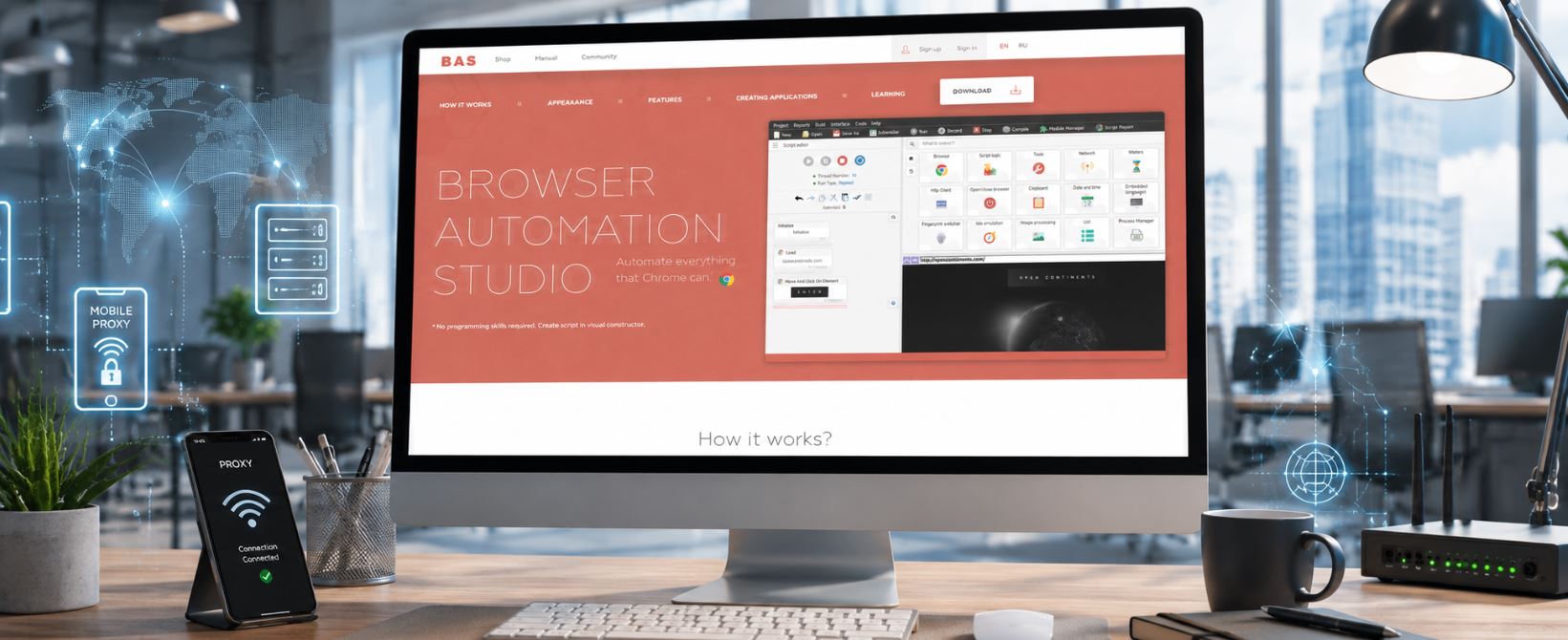
Mobile proxies for BAS are useful when automation should not run through one shared IP address. In BrowserAutomationStudio, this matters most in multithreaded workflows: each thread can process its own part of the task, while proxies distribute requests across separate mobile IPs.
BAS combines a visual automation builder, browser actions, an HTTP client, variables, resources, loops, and multithreading. But multithreading alone does not make a web automation workflow stable. If all threads hit the same source from one IP, the site may quickly detect an unnatural spike in similar requests. That is why a BAS proxy should be selected by stability, IP type, location, rotation control, and the ability to assign a dedicated channel to a specific thread.
A practical use case is collecting public product cards or content pages for a catalog. The goal is not to overload the source with maximum request volume. The goal is to split the work carefully, respect limits, reduce errors, and get clean data.
What BrowserAutomationStudio is and why proxies matter
BrowserAutomationStudio, or BAS, is an environment for building automation scripts without writing every line of code manually. A user builds logic from actions: open a page, find an element, click, send an HTTP request, read a file, write a result, change a variable, run a loop, or start a thread. This makes BAS useful for parsing, testing, website checks, form processing, public data collection, and routine web tasks.
BAS has two common ways to work with the web. The first is browser mode, where the script behaves more like a user in a browser window. The second is the HTTP client, where requests are sent directly without rendering the full page. The HTTP client is usually faster and lighter, but it requires better control of headers, cookies, sessions, pauses, and source limits. In that setup, a browser automation studio proxy becomes part of the architecture, not just an extra field in settings.
Why mobile proxies for BAS
A mobile proxy routes traffic through a mobile operator IP. For a website, this looks like traffic from a mobile network rather than a typical datacenter. This does not mean that a mobile IP allows ignoring website rules, robots.txt, rate limits, or legal restrictions. For legitimate automation, however, mobile addresses often provide a more trusted network layer.
For BAS, this is useful for three reasons. First, mobile IPs are suitable for tasks where location and natural network behavior matter. Second, they are easy to distribute across threads: one thread can use one proxy or one proxy group. Third, mobile networks make controlled IP change possible when a workflow requires rotation after a certain number of actions, errors, or minutes.
Dedicated mobile proxy or shared pool
The main benefit of a dedicated mobile proxy is predictability. If the proxy is used only for your tasks, you have better control over request frequency, session history, and IP reputation. In a shared pool, the situation is less stable: an address that works cleanly today may have been used by many other users for unrelated tasks tomorrow.
A dedicated proxy is also easier to map to thread logic. For example, thread 1 collects smartphones, thread 2 collects laptops, and thread 3 collects accessories. Each has its own IP, cookie session, speed, and error log. If one thread starts receiving many 429, 403, or timeout responses, you can slow down that exact thread instead of stopping the whole workflow.
How BAS uses multithreading
Multithreading in BAS allows several copies of a script to run in parallel. In a good architecture, threads do not simply click faster. They share a task queue: URLs, categories, pagination pages, product IDs, or keywords. Each thread takes the next item, processes it, saves the result, and moves on.
A common mistake is to run too many threads without speed control. This may increase requests per minute on paper, but in practice it often creates more blocks, empty responses, timeouts, duplicates, and retries. A better model is to define an acceptable rate first, split it between threads, and only then add proxies.
BAS HTTP client: when it is better than browser mode
The HTTP client is the right choice when the data is already available in HTML, JSON, or an open API response, and a full browser adds no value. If a product card contains the title, price, image, attributes, and availability in static markup or an open JSON request, the HTTP client will be faster, lighter, and easier to log.
Browser mode is needed when the page depends heavily on JavaScript, complex authorization, dynamic rendering, or interaction with elements. But for collecting public product cards at scale, the HTTP client is often enough. It reduces local machine load, supports more controlled threads, and makes response logging simpler.
How to distribute tasks across mobile IPs
For catalog collection, a queue works best. You prepare a list of URLs or product IDs, add it as a BAS resource, and let threads take items one by one. Each thread gets its proxy, sends a request, checks the response code, parses the required fields, and writes the result to CSV, JSON, a database, or a spreadsheet.
- One thread — one proxy. The most predictable model for dedicated mobile proxies.
- One category — one proxy. Useful when you want to track collection quality by catalog section.
- One proxy — limited request count. After the limit, BAS pauses or changes the IP.
- Rotation after errors. If a thread receives a series of 403, 429, or timeout responses, it slows down or changes the address.
Use case: collecting public product cards for a catalog
Imagine that you need to update a catalog with product names, prices, images, short specifications, availability, and source links. The data is public, does not require bypassing authorization, and is used for comparison or internal analytics. BAS should go through the page list, collect the fields carefully, and avoid unnecessary load on the source.
The correct process starts with a data map. First, define the required fields, where they are located, what to do with missing values, how to remove duplicates, and how to store the update date. Then build a test workflow for 10–20 URLs to validate the parsing logic. Once the logic is stable, add multithreading with separate mobile proxies.
In this case, mobile proxies for BAS are not used for aggressive bypassing. They are used to distribute work in a stable way. The source does not receive one sharp spike from a single IP, and you get clear visibility: which pages were collected, which failed, which need retrying, and which proxy was used.
Rate control is the core of clean collection
Even the best proxy will not fix a poorly designed script. If BAS runs dozens of threads without pauses, retries failed URLs without limits, and ignores server responses, blocks are expected. Every workflow should have rate limits: pauses between requests, per-thread limits, hourly or daily limits, and retry rules.
Adaptive speed is a good practice. If responses are stable, the thread runs at normal speed. If 429, 503, timeouts, or captcha responses appear, the thread slows down. If the issue repeats, the thread pauses or changes IP. This is better than blind rotation after every error.
Practical BAS proxy settings
BAS commonly uses HTTP or SOCKS5 proxies with username and password authentication. The script should clearly define where the proxy is set: in the browser profile, in the HTTP client, or in a separate action before the request. If several threads are used, proxies should be stored as a resource and assigned line by line.
- Check the IP before each thread starts.
- Do not mix cookies between threads unless needed.
- Do not use one proxy for all threads.
- Add timeouts so a stuck request does not block the thread.
- Log response code, URL, proxy, time, and attempt number.
Conclusion
Mobile proxies for BAS are a tool for controlled, stable, and scalable automation. Together with BrowserAutomationStudio, they help separate threads, manage request frequency, use different mobile IPs, and diagnose errors faster. The best workflow is simple: build a stable BAS script first, add a task queue, use moderate multithreading, assign dedicated mobile proxies, and only then scale the process.