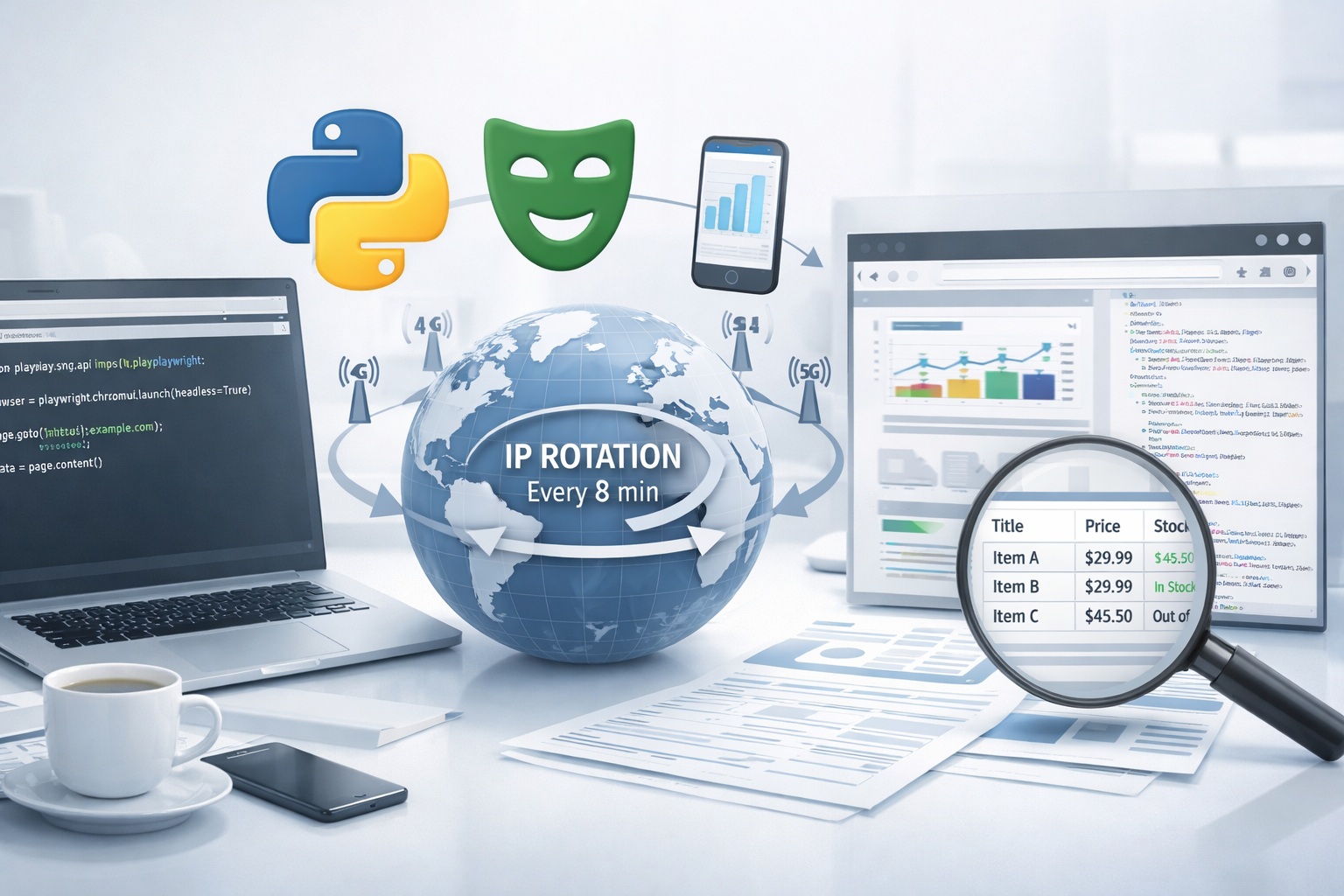
At high scraping volume (10,000+ requests/day), many websites aggressively throttle or block datacenter IPs. Common outcomes include HTTP 429, 403 after a few dozen requests, repeated CAPTCHAs, and honeypot/IDS triggers. 4G/5G mobile proxies make traffic look like it comes from real smartphone users: dynamic IPs from a carrier NAT pool and typically higher trust for anti-bot systems.
Common blocking signals at scale
- HTTP 429 (Too Many Requests)
- 403 Forbidden after 10–30 requests in a session
- CAPTCHA loops (Cloudflare / Google / reCAPTCHA)
- Honeypot hits or IDS/anti-bot triggers
Why mobile proxies tend to perform better
The key difference is IP reputation and rotation behavior. Mobile addresses often belong to shared carrier NAT pools, so they are more likely to resemble regular end-users than server traffic.
| Factor | Datacenter (DC) | Mobile IP |
|---|---|---|
| Anti-bot trust | Low | High |
| Ban after 20–50 requests | Typical | Rare |
| CAPTCHAs | Every 5–15 requests | Once per 200–1000+ |
| Cloudflare / Akamai | Often poor | Usually better |
| IP rotation | Fixed | Dynamic NAT pool |
| Honeypot risk | Medium / high | Low |
Proxy modes for different scraping tasks
| Scenario | Recommended mode | Rotation |
|---|---|---|
| Large datasets, speed matters | Rotating Mobile Proxy | every 6–15 min or 100–300 requests |
| Accounts/logins, long session | Sticky Mobile IP | per session |
| Geo API scanning | Mixed mode + delay | every 3–5 min |
Real case: e-commerce scraping
Goal: collect ~25,000 products + images (UA retail).
Stack: Python + Playwright (headless).
Proxy: dedicated mobile + auto-rotation every 8 minutes.
Load: ~120 req/min.
| Metric | DC proxy | 4G mobile proxy |
|---|---|---|
| 429 errors | 18.6% | 4.3% |
| CAPTCHAs | about every 30 requests | ≈ once per 400–600 |
| Completion time | 8 hours | 3 h 45 m |
| Duplicate-block (honeypot) | 6 cases | 0 cases |
Recommended settings for stable scraping
- Header rotation: User-Agent, Accept-Language, Referer
- Request delay: 200–500 ms (anti-DDoS)
- IP rotation: every 200–300 requests or 5–15 minutes
- Proxy pool: at least 5–10 modems if you run > 3 concurrent streams
- Block JavaScript if it is not required
- For difficult targets, consider headless = OFF and full browser emulation
Top 5 mistakes when scraping with proxies
- Using a single IP for the entire dataset
- No delays between requests
- Using DC/server proxies on heavily protected sites
- Unrealistic headers/language setup and no header rotation
- Running 20 threads from one mobile device
Conclusion
Dedicated 4G/5G proxies with correct rotation typically provide:
- up to 4× fewer 429s and blocks
- 2–3× faster completion time
- higher stability (close to residential, often faster)