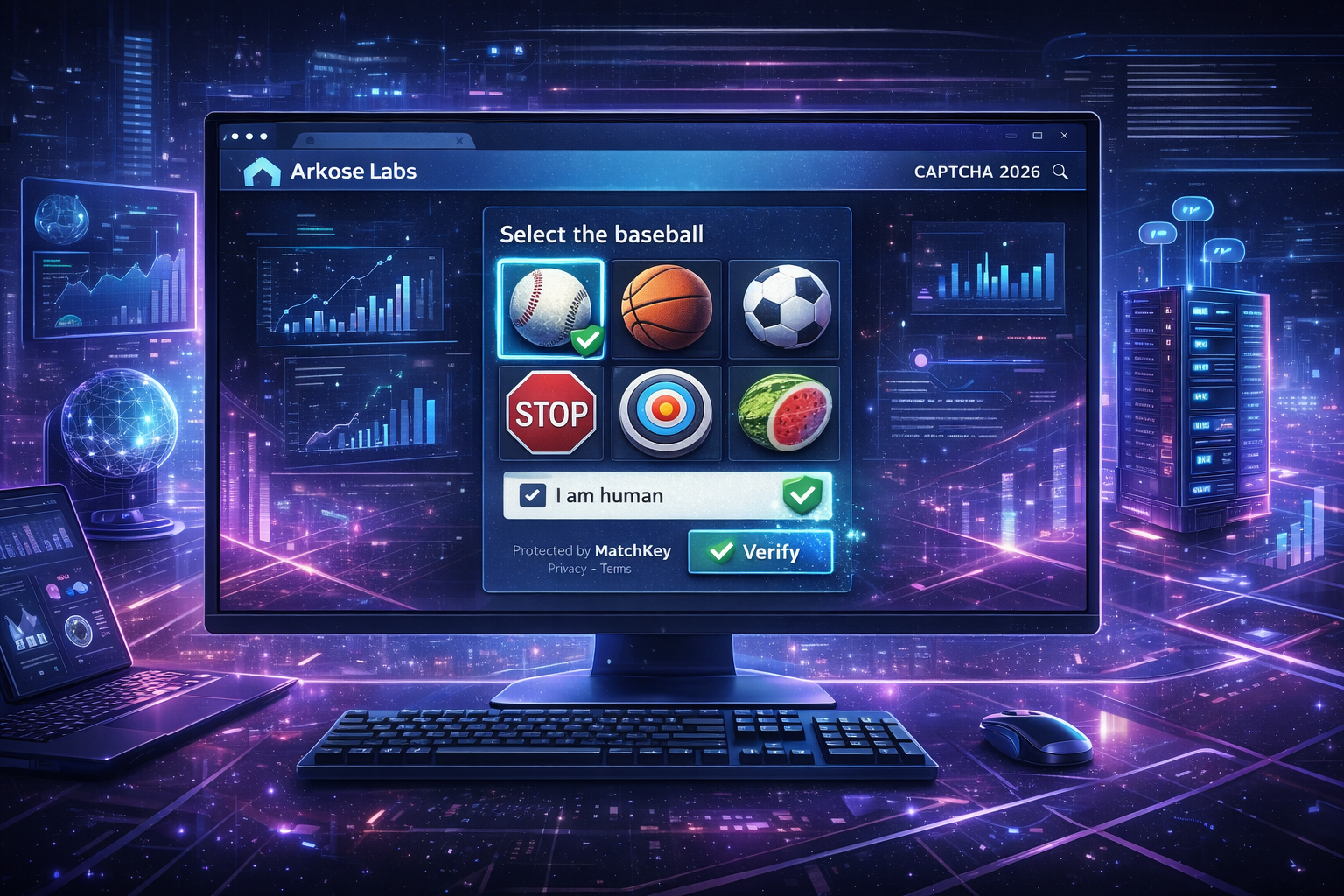
Why CAPTCHAs became almost invisible by 2026
Classic “image puzzle” CAPTCHAs turned into a weak link: they frustrate real users, hurt conversion, and still fail against motivated abuse. Human-solver farms and cheap “captcha-as-a-service” reduce the barrier for attackers, while automation keeps learning common patterns. Modern anti-bot systems therefore shifted to risk scoring: collect multiple signals, estimate abuse probability, and add friction only when the risk justifies it.
The biggest change is less interaction (checkboxes, puzzles) and more background validation. In many flows the user sees nothing: the platform silently evaluates the browser, network attributes, and behavior, then allows the action or escalates to an extra check only for suspicious sessions. That is why in 2026 the key question is not “how to solve a CAPTCHA”, but which signals create trust and how to avoid breaking them during legitimate testing and data collection.
A practical map: three common defense styles
Most products combine three building blocks: front-end challenges (JS/widget), back-end scoring (request/session evaluation), and adaptive friction (escalate only for risky traffic). Turnstile, hCaptcha, and Arkose Labs use all three, with different emphasis.
- Cloudflare Turnstile: a low-friction CAPTCHA replacement that often runs invisibly, focusing on environment and behavior signals.
- hCaptcha (including Enterprise): risk scoring plus “passive” modes where a visible challenge appears only when confidence is low.
- Arkose Labs (MatchKey and related modules): “friction by risk” — normal sessions pass, risky ones face adaptive challenges and deeper device/session signals.
Signal evolution: from puzzles to background profiles
By 2026 defenses typically score a session across three layers:
- Behavior: mouse/touch dynamics, typing patterns, navigation rhythm, pauses, event sequences, form interaction.
- Environment: real browser vs automation; fingerprint stability; consistency across APIs and protocol behavior.
- Reputation: IP/ASN/geo context, historical abuse, repeated patterns across accounts and sessions.
Outcomes are no longer binary. Low risk may pass with no challenge; medium risk may trigger a lightweight check or token; high risk may be blocked, rate-limited, or routed to additional verification.
Behavior signals: what systems look for
Behavior is hard to fake reliably at scale, so it carries a lot of weight:
- Rhythm: perfectly uniform click/scroll intervals, no pauses, and “too perfect” paths can look synthetic.
- Event sequence: real users produce micro-events (hover, focus/blur); bots may jump straight to submit/navigate.
- Text entry: instant field completion, large pastes, identical templates across many accounts.
- Navigation: presence of warm-up browsing vs immediate form/endpoint hits.
For legitimate QA automation, the practical rule is simple: avoid inhuman speed and sterile repetition.
Environment signals: browser, JavaScript, and transport layer
Defenses increasingly evaluate traffic “from network to DOM”: part of the assessment happens before JavaScript runs.
- JS consistency: Web API availability and coherence, navigator properties, timing characteristics, canvas/WebGL/audio behaviors.
- HTTP/2 and headers: typical header sets and ordering, coherence between User-Agent and other signals.
- TLS fingerprinting: TLS handshake parameters often form a stable transport-layer client signature.
For legitimate engineering, a key principle is do not make your client “exotic”. Patched browsers, unusual proxy chains, or rare signal combinations can raise risk on their own.
IP reputation: why “clean” matters
IP reputation remains a strong predictor. Systems evaluate context, not just the raw IP:
- ASN and network type: data center ranges are more often associated with automation; residential/mobile ranges with typical users (not a guarantee).
- Geo coherence: rapid location jumps for the same account/session; cumulative inconsistencies (language/timezone vs location).
- Sharing and NAT: many sessions behind one IP can inherit “collective” reputation.
- Abuse history: spam, brute force, suspicious logins, aggressive scraping patterns.
“Invisible” checks: tokens, risk scores, and conditional challenges
Invisible does not mean absent. A common flow looks like this:
- a page or background request obtains a short-lived verification token bound to the session;
- the server validates it and receives a risk score or allow/challenge/block decision;
- on higher risk, the system escalates: show a widget, request a retry, add verification, or tighten rate limits.
This is why you may see “silent” 403/429 responses without any visible CAPTCHA.
Turnstile vs hCaptcha vs Arkose: how to think about them
- Turnstile: low-friction token-based validation; often best for forms and onboarding where conversion matters.
- hCaptcha Enterprise: flexible mix of passive and interactive modes with risk scoring; useful when you need tunable thresholds.
- Arkose (MatchKey): stronger in motivated abuse scenarios (ATO/fraud/abuse) with adaptive challenges that are “costly” for attackers.
In all cases, the key is not the widget itself but the policy: thresholds, escalation paths, logging, and a recovery flow for false positives.
Legitimate testing: how to reduce false positives
QA automation, load tests, availability monitoring, and compliant collection of public data can look suspicious due to repetition and speed. Practical mitigations:
- Separate environments: staging/QA domains, softer rules, or whitelisting for test IP ranges.
- Transparent identification: a dedicated User-Agent for monitoring and correct headers (where appropriate).
- Rate control: limits per second/minute, randomized pauses, controlled concurrency.
- Session realism: cookies and state; reuse sessions instead of starting “clean” every request.
- Logging: capture response codes, headers, timings, token generation/validation points to pinpoint failures.
Checklist for compliant data collection
- Confirm terms of use and whether an official API exists.
- Do not impersonate humans when official access or partner integrations are available.
- If you need a browser, stick to stable builds and avoid exotic patches/randomization stacks.
- Avoid traffic spikes; prefer steady schedules.
- Treat 403/429 as a signal to back off; reduce rate and retry later.
- Separate human and automated traffic by keys/domains/routes.
Common causes of false blocks in 2026
- default headless fingerprints and telltale automation artifacts;
- signal mismatches (UA says Chrome, transport looks like a library);
- highly repetitive, deterministic flows;
- poor egress reputation or too many sessions per IP;
- overly aggressive risk thresholds on production traffic.
Conclusion
In 2026 anti-bot protection is no longer “add a CAPTCHA”. It is an ecosystem of risk scoring, invisible checks, reputation layers, and adaptive friction. Turnstile, hCaptcha, and Arkose implement the same core idea differently: minimize friction for legitimate users and make abuse expensive. For legitimate testing and compliant data collection, focus on predictability, respectful rate limits, realistic sessions, and clear separation between test and production environments.
FAQ
- Why do I get blocked without seeing a CAPTCHA?
Because the decision is made in the background via risk scoring, often returning a direct deny or tighter limits. - Which signals matter most?
Behavior, environment consistency (browser/network), and IP reputation — especially their combination. - Can I use automation for legitimate QA?
Yes, with staging/whitelisting, controlled rates, transparent identification, and human-like interaction patterns.